Last updated July 15, 2026
The Complete Guide to Gate Repair in Las Vegas
Most gate repair calls in Las Vegas don’t start with one problem — they start with three, and only the last one is visible. A post shifted half an inch during a heat cycle six months ago. That shift put uneven load on the hinge arm. The hinge arm wore down the drive gear. Now the motor is grinding and you’re calling for a motor repair, but the motor was the last domino, not the first. This Gate Repair guide breaks down every layer of a gate system — structural, mechanical, electrical, and access control — so you know exactly what failed, why it failed in Las Vegas’s specific climate, and what a real repair looks like from diagnosis to close.
Quick Answer
Gate repair in Las Vegas covers four overlapping disciplines: structural metalwork, mechanical alignment, motor and drive systems, and electronic access control. Most gate problems in Las Vegas are caused or accelerated by extreme heat cycling — temperatures that regularly swing 60°F between day and night — which warps posts, loosens hardware, and degrades wiring insulation over time. A complete repair addresses the root cause, not just the symptom you can see.
Table of Contents
- How Las Vegas Heat Cycles Cause Cascading Gate Failures
- The Four Disciplines of Gate Repair — and Why Most Companies Cover Only One or Two
- What a Complete Gate Diagnostic Actually Looks Like
- Brand-Specific Repair Realities: LiftMaster, FAAC, Viking, and Beyond
- When to Repair vs. When to Replace
- Access Control: The Layer Most Gate Techs Skip
- Common Mistakes to Avoid
- When to Call a Professional
- Frequently Asked Questions
- The Bottom Line
How Las Vegas Heat Cycles Cause Cascading Gate Failures
Las Vegas doesn’t just get hot — it cycles. In the summer months, surface temperatures on metal gate components can exceed 160°F during the afternoon and drop below 80°F overnight. That 80°F daily swing causes steel posts and frames to expand and contract by measurable fractions of an inch, every single day. Over one Las Vegas summer, a gate post can accumulate enough micro-movement to shift its foundation anchor by a quarter inch. That might sound minor, but it’s not.
Here’s the sequence we see repeatedly in neighborhoods like Summerlin, Henderson, and the southwest Las Vegas valley: the post shifts, changing the gate’s hang angle. The gate now drags slightly on the roller track or pulls unevenly on the hinge. The motor compensates by drawing more current — 10%, then 20% more than spec — which heats the control board. Over weeks, the board’s capacitors degrade. One morning, the gate stops mid-cycle. The homeowner calls for a control board replacement. A tech who swaps the board without checking the post sets the same failure in motion again.
UV exposure compounds this. Wiring insulation in Las Vegas becomes brittle and cracks within 3–5 years when not properly conduit-protected. Limit switch contacts oxidize. Receiver antennas lose sensitivity. Each of these is a separate failure mode, but they share the same root: a climate that is genuinely hostile to gate hardware and punishes any installer or technician who ignores it.
A proper Las Vegas gate repair always starts with a structural and environmental check before anything electronic is touched.
The Four Disciplines of Gate Repair — and Why Most Companies Cover Only One or Two
Gate repair in Las Vegas is not one trade. It’s four distinct disciplines that overlap on every job, and the gap between companies usually comes down to how many of these four they actually handle in-house. For a full breakdown of what to check before calling a pro, see our Gate Repair Maintenance Checklist for Las Vegas Homeowners.
1. Structural / Fabrication
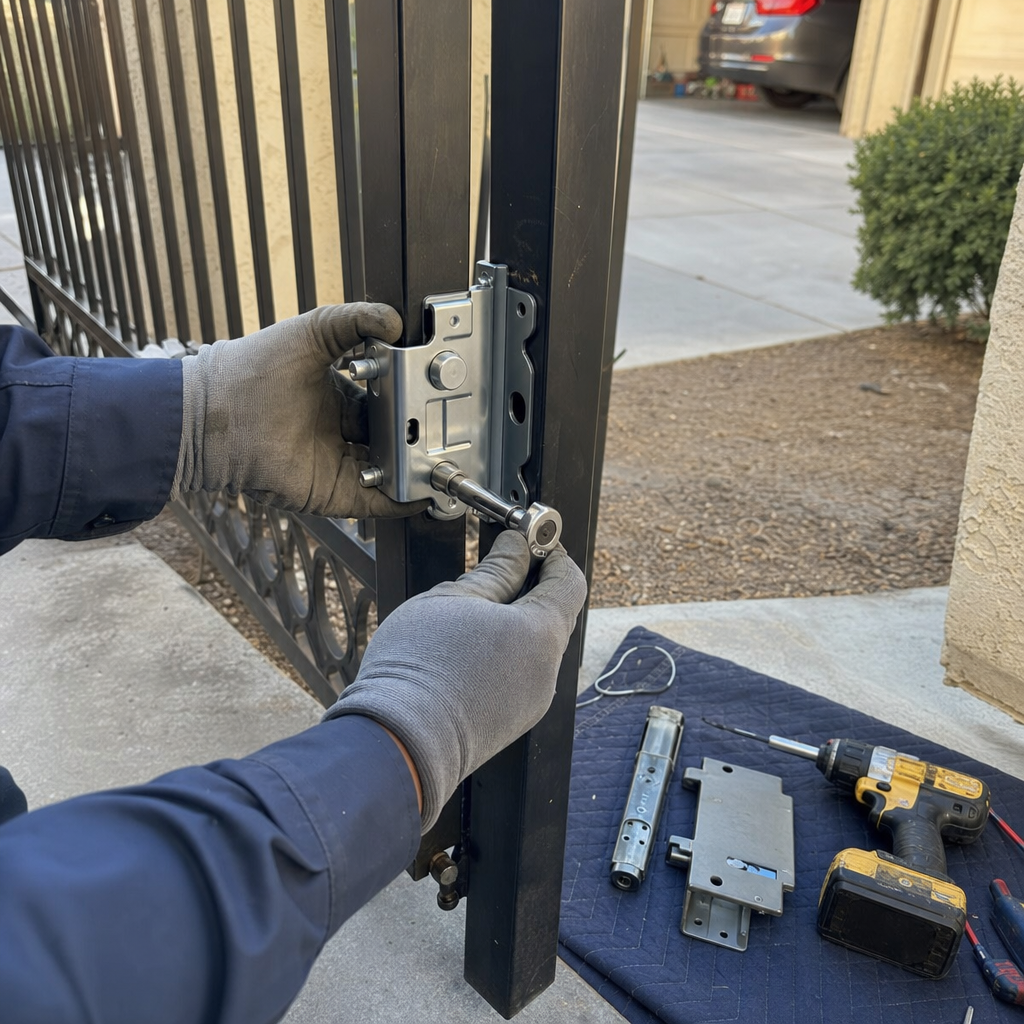
This covers the gate frame, posts, hinges, rollers, and tracks — the physical metal that makes up the gate itself. Bent frames, cracked welds, seized hinges, broken hinge plates, and shifted posts all live here. Fixing structural problems requires welding equipment, metal fabrication skills, and an understanding of load-bearing geometry. Most gate “repair” companies don’t carry a welder. They’ll diagnose a structural problem and refer you elsewhere — or worse, they’ll put a motor on a gate that’s structurally compromised and call it done.
2. Mechanical Alignment
This is the adjustment layer: roller height, chain tension, travel limits, gate balance, and the physical relationship between all moving parts. A gate that’s mechanically out of alignment will destroy a new motor in months. Mechanical work doesn’t require welding, but it does require knowing what “correct” looks and sounds like across different gate types — swing, slide, bi-fold, and vertical lift.
3. Motor and Drive Systems
This is where most gate techs spend their time — and where most of their knowledge ends. Motors, gearboxes, drive chains, limit switches, control boards, transformers, and solar charging systems all belong here. Brand fluency matters enormously in this layer because LiftMaster’s diagnostic interface, FAAC’s parameter menus, and Viking’s board architecture are completely different animals. A tech who knows one brand deeply and another superficially will make expensive mistakes on the second one.
4. Electronic Access Control
Keypads, intercoms, card readers, loop detectors, telephone entry systems, and smart-home integrations sit at this layer. In Las Vegas’s commercial corridor — properties along Sahara, Flamingo, and the industrial parks near Nellis — access control is often the reason a gate gets installed at all. This layer requires low-voltage wiring knowledge, brand-specific programming access, and occasionally coordination with network infrastructure. It’s almost never addressed by companies that focus purely on mechanical repair.
At All Star Gate Repair Las Vegas, Gerald and his team work across all four disciplines on every job — structural welding included — because a repair that ignores any one layer is only a partial fix.
What a Complete Gate Diagnostic Actually Looks Like
A thorough gate diagnostic isn’t a five-minute walk-around. Here’s what it should include, in order:
- Visual structural inspection: Check the post for plumb (vertical alignment), inspect welds at the hinge plate, look for frame bends or stress cracks, and examine the track or roller channel for debris and deformation.
- Manual operation test: Disconnect the motor and push or swing the gate by hand. A properly aligned gate should move with minimal resistance. Binding, grinding, or uneven drag indicates a mechanical or structural issue that will stress any motor.
- Motor and board power check: Measure input voltage at the transformer and output voltage at the board. Check for blown fuses, burned terminals, and capacitor swell. In Las Vegas heat, capacitor failure is one of the top three causes of gate motor stoppage.
- Limit switch and travel calibration: Confirm that open and close limits are set correctly and that the gate reaches full travel without hunting or reversing unexpectedly.
- Safety device test: Test photo-eye alignment, obstruction sensing, and any loop detectors. Las Vegas code requires functional safety reversal on automated gates in commercial applications.
- Access control function check: Test every entry method — keypad, remote, intercom, card reader — and confirm signal integrity at the receiver.
- Wiring and conduit inspection: In Las Vegas’s UV environment, this step catches cracked insulation and corroded connections before they become intermittent failures.
A tech who skips steps one through three and goes straight to replacing the obvious failed part isn’t diagnosing — they’re guessing. The difference matters to your wallet and to the life of the repair.
Brand-Specific Repair Realities: LiftMaster, FAAC, Viking, and Beyond
Brand matters more in gate repair than most homeowners realize. Parts availability, programming access, and diagnostic capability vary dramatically between manufacturers — and between their residential and commercial product lines.
LiftMaster
LiftMaster is the most common residential gate operator in Las Vegas by a significant margin, which means parts are readily available and most experienced techs have worked on them. The LA400, LA500, and CSL24U are the units we service most often. LiftMaster’s myQ integration and Security+ 2.0 radio protocol require proper programming — cloning a remote incorrectly will lock out the entire system. Board replacements require correct DIP switch or EEPROM configuration to avoid losing travel settings.
FAAC and BFT
FAAC and BFT are Italian-manufactured commercial operators found on higher-end residential and commercial properties — often in the communities along the eastern edge of Summerlin and in commercial centers near the 215. Both brands use hydraulic or electromechanical actuators with parameter menus that require dealer-level programming access. Parts are not off-the-shelf; lead times from distributors can run 5–10 business days, which is why a tech who works these brands regularly keeps common components stocked.
Viking and Linear
Viking operators are workhorses found throughout Las Vegas’s commercial and light-industrial properties. Their control boards are field-configurable with DIP switches, which makes them repairable by an experienced tech without proprietary software. Linear is common in multi-unit residential and HOA-managed communities — their telephone entry and access control products tie directly to their gate operators, so a board failure often brings down the entire entry system simultaneously.
Ghost Controls, Mighty Mule, and Elite
These brands cover the residential swing gate market — common in older Las Vegas neighborhoods with single-family driveways where the gate posts predate the motorization. Ghost Controls and Mighty Mule use solar-friendly low-current draw systems well-suited to Las Vegas’s solar potential, but their actuator arms are sensitive to post alignment; even minor post shift causes premature gear wear. Elite operators occupy the mid-tier, with parts support that is adequate but not deep.
DoorKing
DoorKing (DKS) telephone entry systems appear in apartment complexes, storage facilities, and gated communities throughout the Las Vegas valley. Their systems integrate telephone entry, access control, and gate operation in one platform. Repairs require DoorKing’s proprietary software for programming and user database management — a tech without that access will hit a wall on anything beyond basic mechanical work.
Our team carries parts inventory and programming tools for all nine brands we service. When you call, the first question we ask is what brand and model you have — because knowing that in advance is the difference between a same-day repair and a parts-wait.
When to Repair vs. When to Replace
The honest answer to “should I repair or replace?” depends on three variables: the structural integrity of the existing gate, the age and availability of parts for the operator, and the cost ratio between the repair and a new installation. Here’s how to think through it:
Repair is almost always the right call when:
- The gate frame and posts are structurally sound and plumb
- The operator is under 10 years old and parts are available
- The failure is a single component — board, motor, limit switch, hinge — rather than systemic wear
- The repair cost is under 50% of a comparable new installation
Replacement becomes worth considering when:
- The gate frame has multiple stress cracks or the posts have shifted beyond cost-effective realignment
- The operator is 12+ years old, parts are discontinued, and the control board architecture is no longer serviceable
- Multiple systems have failed simultaneously — structural, mechanical, and electrical — indicating the whole system aged out at once
- The access control technology has fallen so far behind current standards that it’s creating security gaps (common with pre-2015 DoorKing and Linear telephone entry systems)
In our experience across Las Vegas, roughly 70% of gate calls are repairable without any structural replacement. The gates most likely to need full replacement are those that were installed on inadequate posts in the first place — a shortcut by the original installer that the Las Vegas heat eventually exposes. For a closer look at what a new installation involves when replacement is the right answer, our Gate Installation in Spring Valley page walks through the process and what to expect.
Access Control: The Layer Most Gate Techs Skip
Access control is where a gate system earns its keep for commercial property owners and HOA-managed communities in Las Vegas — and it’s the layer most mechanical gate techs walk past without comment. A gate that opens and closes reliably but has a keypad that accepts any four-digit code, or a telephone entry system with 200 outdated user entries, isn’t actually providing security. It’s providing the appearance of security.
The access control layer includes:
- Keypads and PIN entry — programming individual user codes, setting time-restricted access windows, and clearing compromised codes
- Telephone entry systems — DoorKing and Linear systems that call a resident or manager’s phone to grant access; require database management and phone number updates
- Card and fob readers — proximity credentials used in commercial applications; require reader programming and credential issuance
- Vehicle loop detectors — inductive loops cut into the pavement that detect vehicle presence for exit triggers and safety; Las Vegas asphalt expansion can shift loop geometry over time
- Smart-home integration — LiftMaster’s myQ platform and compatible receivers allow smartphone control of residential gate operators
- Intercom systems — audio and video intercoms for residential and commercial entry; wiring in Las Vegas’s heat requires shielded cable to prevent signal degradation
When we service a gate, we check every active access method — not just the one the customer called about. A keypad that works but a loop detector that’s been bypassed is a half-repaired system. For properties in Las Vegas that need motor and access control addressed together, our Gate Motor & Opener in Spring Valley service page covers how we approach that integration.
Common Mistakes to Avoid
- Replacing the motor without checking the structural alignment first. A new LiftMaster or FAAC motor on a gate with a leaning post will fail within 12–18 months in Las Vegas’s heat. The motor is the symptom; the post is often the cause.
- Using big-box replacement parts for commercial operators. FAAC, BFT, and Viking operators require OEM or certified-compatible components. Generic boards sourced from marketplace sellers frequently have incompatible relay configurations that cause erratic behavior or void any warranty on the new part.
- Ignoring cracked wiring insulation during a repair visit. In Las Vegas, UV-degraded wire insulation is almost universal on systems older than five years. A tech who replaces a control board without addressing a cracked wire 18 inches away is leaving a failure on a timer.
- Hiring a general fence contractor for structural gate work. Fence contractors weld — but gate frame repair requires understanding load paths, hinge geometry, and how the structural repair will interact with the motor’s torque arm. Getting those wrong shortens the life of the entire repair.
- Programming remotes without clearing the existing code library. On LiftMaster and Linear systems especially, adding a new remote to a full or corrupted code library causes intermittent access failures. A clean programming cycle takes five extra minutes and prevents a callback.
- Accepting a diagnosis without a manual operation test. If a tech plugs in a control board before pushing the gate by hand to check for binding, they haven’t diagnosed the system — they’ve only checked the electrical layer. Insist on a manual test before any parts are quoted.
- Delaying repair on a partially working gate. A gate that opens but doesn’t close — or closes slowly and reverses — is a gate that’s destroying its operator on every cycle. In Las Vegas’s heat, the added thermal stress accelerates component wear exponentially. What costs $200 in parts today becomes a $600 board-and-motor job in two months.
When to Call a Professional
Call a gate repair professional — or follow our guide on How to Hire a Gate Repair Contractor in Las Vegas: A Step-by-Step Guide — any time the gate’s motor is drawing power but the gate isn’t moving. That’s a mechanical binding or structural alignment issue, not just a dead part, and diagnosing it wrong is expensive. You should also call when a control board has failed on a commercial operator like FAAC, BFT, or DoorKing, because reprogramming those systems after a board swap requires manufacturer-level software access that isn’t publicly available. Any structural failure — a cracked weld, a broken hinge plate, a post that’s visibly leaning — needs a technician with on-site welding capability, not just a parts-swapper. And if any gate on a commercial Las Vegas property fails to reverse on obstruction, that’s a safety compliance issue that needs same-day attention.
All Star Gate Repair Las Vegas offers free estimates — call (725) 356-1660 and Gerald or a member of the team will walk through your system over the phone before anyone rolls a truck.
If you’re in the southwest valley and need service closer to home, our Gate Repair in Spring Valley page covers that service area in detail.
Frequently Asked Questions
How much does gate repair cost in Las Vegas?
Gate repair in Las Vegas typically ranges from $150–$250 for a single mechanical adjustment or minor electrical fix, $300–$600 for a control board replacement or motor swap on a residential operator, and $700–$1,500+ for commercial operator repairs or jobs that combine structural welding with motor service. Las Vegas’s heat-related wear means parts often need replacement sooner than in cooler climates, so getting a diagnosis before agreeing to any quote is important. Call (725) 356-1660 for a free estimate — we’ll tell you what you’re actually looking at before any work begins.
Why does my gate keep reversing before it fully opens or closes?
Unexpected reversals are almost always caused by one of three things: an obstruction sensor or photo-eye that’s out of alignment (very common after wind events in Las Vegas), a travel limit setting that’s drifted out of calibration, or a gate that’s mechanically binding — which triggers the motor’s built-in overload protection. The third cause is the most expensive if ignored, because every reversal under load stresses the gearbox. Have the mechanical alignment checked before assuming the sensor or board is at fault.
Can you repair FAAC or BFT gates in Las Vegas?
Yes — Gerald and our team service FAAC and BFT operators directly, including control board replacements that require parameter reprogramming. These brands are common on higher-end residential properties and commercial sites in Las Vegas, and they require dealer-level programming access that most general gate techs don’t carry. We stock common FAAC and BFT components and can typically complete repairs without multi-day parts waits. Call (725) 356-1660 to confirm parts availability for your specific model before scheduling.
How long do gate motors last in Las Vegas?
In Las Vegas’s climate, residential gate operators typically last 8–12 years with regular maintenance — compared to 12–15 years in cooler markets. Commercial operators on high-cycle applications (apartment complexes, parking facilities) often need service or component replacement at the 5–7 year mark. The main accelerants are heat-related capacitor degradation, UV damage to wiring, and the cumulative effect of operating a mechanically misaligned gate. Annual maintenance inspections are a practical way to catch the components aging fastest before they cause a full system failure.
Do I need a permit to repair my gate in Las Vegas?
In most cases, like-for-like gate motor repair or replacement on an existing residential system in Las Vegas does not require a permit from Clark County or the City of Las Vegas. For deeper detail, read Gate Repair Permits, Codes & Inspections in NV: What You Need to Know. However, if you’re adding new electrical service to the gate location, installing a new post, or making structural changes that alter the gate’s footprint, a permit may be required. Commercial properties have stricter requirements, particularly around safety reversal compliance and access control changes. When in doubt, we can confirm the applicable requirements for your specific job during the estimate call.
What’s the difference between a gate operator and a gate opener?
The terms are used interchangeably in everyday conversation, but technically: a gate opener is the consumer-grade term for residential motorized gate units like Mighty Mule or Ghost Controls, while gate operator typically refers to commercial-grade electromechanical or hydraulic units like those made by FAAC, Viking, or LiftMaster’s commercial line. The practical difference is duty cycle — a residential opener might be rated for 10–15 cycles per day, while a commercial operator handles 50–200+ cycles. Putting a residential opener on a gate that sees commercial traffic is one of the most common causes of premature motor failure we see in Las Vegas.
The Bottom Line
Gate repair in Las Vegas is more complex than it looks from the outside, and Las Vegas’s climate makes every layer of a gate system work harder than it would almost anywhere else in the country. The key takeaways from this guide — with more guides & resources available on our blog: structural problems cause motor failures, not just the other way around; most gate companies handle one or two of the four repair disciplines, not all four; brand fluency is non-negotiable when you’re working on FAAC, BFT, DoorKing, or Viking systems; and a real diagnostic starts with a manual operation test, not a parts quote. Fix the root cause, and the repair holds. Fix only the symptom, and you’ll be calling again in six months.
Gerald Russell and the All Star Gate Repair team have spent five years working through exactly these problems across Las Vegas — 189 customer reviews averaging 4.9 stars reflect that approach. If your gate isn’t working the way it should, call (725) 356-1660 for a free estimate. We’ll diagnose the whole system, tell you exactly what’s wrong and why, and give you an honest answer on whether repair or replacement makes more sense for your situation. No pressure, no upsell — just a straight answer from the person who’ll actually be on the job.
Written by Gerald Russell, Owner & Lead Technician at All Star Gate Repair Las Vegas, serving Las Vegas since 2021.