
Last updated July 15, 2026
Gate Repair Maintenance Checklist for Las Vegas Homeowners
Most gate maintenance guides were written by people who’ve never worked in a climate where it hits 117°F in July, where caliche dust coats everything within a week of cleaning, and where wiring insulation can crack from UV exposure alone in under three years. The checklist that keeps a gate running in Portland is not the checklist that keeps one running in Las Vegas. What we’ve built here — after five years of diagnosing gate failures across Summerlin, Henderson, North Las Vegas, and the surrounding valley — is the checklist that actually reflects what fails out here, and why. Follow it, and you’ll catch the problems before they strand your gate open at midnight.
Quick Answer
A Las Vegas gate maintenance checklist should cover six core areas every six months: caliche and alkali dust removal from motor housings and control boards, UV-damage inspection on all exposed wiring, thermal expansion gap measurement at the gate frame, desert-rated lubrication on all moving parts, battery backup testing, and hardware torque checks. Most residential gates in Las Vegas need more frequent attention than manufacturer schedules suggest — the Mojave’s heat, dust, and UV index accelerate wear on every component.
Table of Contents
- 1. Caliche & Alkali Dust: The Las Vegas Gate Killer Most Homeowners Miss
- 2. UV Wiring Degradation: What to Look for at 2, 5, and 10 Years
- 3. Thermal Expansion Gaps: Seasonal Alignment in the Desert
- 4. Lubrication Schedule for Desert Conditions
- 5. Battery Backup Systems: Why Las Vegas Power Fluctuations Matter
- 6. Hardware, Hinges, and Structural Inspection
- 7. Access Control and Safety Sensor Check
- Common Mistakes to Avoid
- When to Call a Professional
- Frequently Asked Questions
- The Bottom Line
1. Caliche & Alkali Dust: The Las Vegas Gate Killer Most Homeowners Miss
Here’s the item that belongs at the top of every Las Vegas gate maintenance checklist and appears on none of them: caliche dust infiltration into your motor housing and control board. Caliche is the calcium-carbonate-rich, alkaline soil crust that makes up the ground throughout the Mojave basin. When it dries and gets disturbed — by wind, traffic, or landscaping — it becomes an ultra-fine, mildly conductive powder. It doesn’t just settle on the outside of your gate operator. It works its way through every unsealed gap in the housing and coats circuit board traces, relay contacts, and limit switch assemblies. Over a season or two, that dust layer can cause false limit trips, intermittent motor failures, and eventually a short that takes out the control board entirely.
In our experience serving Las Vegas neighborhoods from the southwest valley to the east side, caliche-related motor failures are among the most preventable we see — and the most expensive when they’re ignored. A new control board for a LiftMaster or FAAC operator runs $150–$400 in parts alone. Compressed air and a visual inspection twice a year costs nothing.
How to Inspect and Clear Caliche Dust
- Power down the gate operator at the circuit breaker before opening the housing — never work inside a live control box.
- Open the operator cover and use a flashlight to inspect the control board, wiring terminals, and limit switch assembly for a fine grey-white powder coating.
- Use short bursts of compressed air (under 30 PSI) to clear dust from the board — hold the nozzle at least four inches away to avoid dislodging components.
- Wipe the housing interior with a dry microfiber cloth. Do not use spray cleaners inside the housing.
- Inspect the housing gasket and any conduit entry points. If you can feel a draft through a gap, seal it with self-fusing silicone tape rated for outdoor use.
- Repeat this inspection every six months — April and October are ideal timing for Las Vegas conditions.
Brands like Viking and DoorKing use tighter housings than some entry-level operators, but no residential gate operator is fully sealed against sustained desert dust exposure without additional weatherproofing.
2. UV Wiring Degradation: What to Look for at 2, 5, and 10 Years
Las Vegas sits at roughly 2,000 feet elevation with a UV index that regularly hits 11 — the highest category on the scale — for four to five months of the year. Standard PVC wiring insulation isn’t engineered for that sustained UV load. What you’d expect to last ten years in a shaded installation starts breaking down in three to five years when it runs along a sun-exposed gate post or spans an open driveway run above ground.
The failure mode is gradual: the outer jacket becomes brittle, develops micro-cracks, and eventually splits. At that point, you have exposed conductors near a metal gate frame — a combination that causes intermittent faults at best, and fires or complete control board damage at worst.
UV Wiring Inspection by Age
- At 2 years: Look for surface chalking or fading on any wiring that runs in direct sun. The jacket should still be flexible. Gently bend exposed wire runs — if the insulation feels stiff or you hear a slight crackling sound, that wire is already degrading faster than normal. Flag it for replacement within the next service cycle.
- At 5 years: Inspect every above-ground wire run from the operator to any keypad, loop detector, or safety sensor. Look for visible cracking along the jacket, discoloration at entry points where wire meets conduit, and any spots where the jacket has pulled back from a connector. Any cracked wire at five years in Las Vegas should be replaced now, not monitored.
- At 10 years: Assume that any original wiring still running in direct sun has reached end-of-life, regardless of visual appearance. At this stage, re-routing into UV-rated conduit or replacing with direct-burial rated wire is standard practice, not optional maintenance. Ghost Controls and Mighty Mule systems installed on residential swing gates are particularly susceptible because their wiring runs are often left partially exposed during original installation.
When replacing wiring, specify THWN-2 or UV-rated direct-burial wire rated for 90°C wet and dry conditions. Standard THHN is not sufficient for Las Vegas surface temperatures, which can exceed 160°F on dark conduit faces in July.
3. Thermal Expansion Gaps: Seasonal Alignment in the Desert
A steel or aluminum gate that fits perfectly in February can bind hard against its stop in August. Las Vegas temperature swings — from lows near 32°F in January to highs above 110°F in summer — put a significant thermal expansion load on any metal gate frame. A twenty-foot steel driveway gate can change dimension by as much as a quarter inch across that range. That may sound small until your gate starts grinding against a post, throwing a motor overload fault, and forcing the operator to work against resistance on every cycle.
How to Measure and Adjust Thermal Expansion Gaps
- Check your gate gaps in the morning during summer (before peak heat) and again in the late afternoon. If the gap at the latch post is noticeably tighter in the afternoon, your summer gap is too tight.
- For swing gates, the gap between the gate frame and the latch post should be at least ⅜ inch in the cooler months to allow for summer expansion. Less than ¼ inch in cool weather will produce binding in summer heat.
- For sliding gates, inspect the gap between the gate leading edge and the stop post. The gate should not contact the stop under its own momentum — the operator should bring it to rest ½ to 1 inch before contact.
- Adjust hinge positions or gate stops in October, before winter. Re-check in April, before the first heat wave. Both FAAC and BFT swing gate operators have built-in torque limits that will throw an error code if the gate binds — don’t reset the error without first identifying and correcting the mechanical cause.
- If your gate has developed a visible bow or twist over time, that’s not a gap issue — that’s a structural issue requiring weld repair or frame correction. No amount of limit switch adjustment compensates for a gate that’s no longer square.
4. Lubrication Schedule for Desert Conditions
The most common lubrication mistake we see on Las Vegas gate service calls: someone used WD-40. WD-40 is a water displacer, not a lubricant — it evaporates quickly, leaves a thin residue that attracts caliche dust, and provides no lasting protection in heat above 80°F. In Las Vegas, where hinges and chain drives operate in summer temperatures that routinely exceed 110°F, the wrong lubricant makes things worse.
What to Use and Where
- Hinges and pivot points: Use a lithium-based grease rated for use above 300°F (look for NLGI Grade 2 lithium complex). Apply with a grease gun at the zerk fitting if present, or pack manually if not. Every six months.
- Chain and rack drives: Use a chain lubricant specifically rated for high-temperature use — commercial chain lube designed for motorcycle or industrial use works well. Apply sparingly and wipe excess to avoid dust accumulation. Every six months, or whenever the chain sounds dry under load.
- Slide gate rollers and track: Dry PTFE (Teflon) spray or a light silicone spray — both hold up in heat without attracting dust the way wet lubricants do. Reapply every four months in Las Vegas conditions.
- Worm gear drives (common in LiftMaster and Linear operators): These are factory-greased and sealed — do not open the gearbox and add lubricant unless you’ve confirmed the factory grease has been depleted. Over-greasing can push grease into the motor windings.
- What to avoid everywhere: WD-40, 3-in-1 oil, and generic spray lubricants with no high-temperature rating. They all fail above 100°F and create a dust-trapping residue on metal parts.
5. Battery Backup Systems: Why Las Vegas Power Fluctuations Matter
Las Vegas sits on a grid that takes real stress during summer demand peaks. NV Energy regularly issues conservation alerts during July and August heatwaves, and localized power fluctuations — brief sags, micro-outages, and brownouts — are common in residential areas west and northwest of the Strip. We see this particularly in newer developments in Summerlin and the northwest valley during peak cooling months. Those fluctuations are hard on standby batteries. A gate operator battery backup that sits at float charge through normal conditions gets cycled partially every time the grid dips — and partial cycling without full recovery shortens lead-acid battery life significantly.
Battery Backup Maintenance Steps
- Test your battery backup every 90 days during summer (May through September). Disconnect AC power to the operator, cycle the gate five times, and confirm it completes all five cycles cleanly. A healthy battery should handle 30–50 cycles before significant voltage drop.
- Check battery terminal connections for corrosion. In desert heat, the outgassing from lead-acid batteries accelerates terminal oxidation. Clean terminals with a small wire brush and apply dielectric grease after cleaning.
- Replace residential backup batteries every 18–24 months in Las Vegas — not the 3-5 years manufacturers quote for moderate climates. Heat is the primary killer of lead-acid batteries, and Las Vegas summer heat is severe.
- If your operator uses a sealed AGM battery (common in Elite and Viking commercial operators), follow the same 18-24 month replacement schedule. AGM batteries tolerate heat better than flooded lead-acid, but they still degrade faster in desert conditions than manufacturer specs assume.
- Never leave a gate system on battery power indefinitely during an outage without cycling the gate — deep discharge below 50% state of charge permanently reduces capacity.
6. Hardware, Hinges, and Structural Inspection
Gate hardware failures in Las Vegas often look like motor problems. A gate that’s slow to open, reverses unexpectedly, or trips the motor’s overload protection isn’t always telling you the operator is failing — more often, it’s telling you that something in the mechanical system is forcing the motor to work harder than it should. Before any motor diagnostic, a complete hardware inspection should be the first step.
Hardware Inspection Checklist
- Hinge bolts and welds: Check every hinge mounting point for loose bolts, cracked welds, and rust migration under paint. In Las Vegas, the thermal cycling from summer highs to winter lows stresses weld points on steel hinges over time. Any hinge with visible weld cracking needs professional attention — that’s a structural failure in progress, not a cosmetic issue.
- Post condition: Inspect the base of every gate post at the concrete collar. Las Vegas soil conditions, particularly in areas with high alkali content, can accelerate steel post corrosion at the soil line. Tap the post at grade level — a hollow sound suggests the post wall is thinning from the inside.
- Gate frame squareness: Step back and look at your gate from 20 feet away. A gate that was originally square will show visible rack (parallelogram distortion) as frame welds fatigue. A racked gate won’t seal, won’t latch reliably, and puts side-load stress on the operator arm.
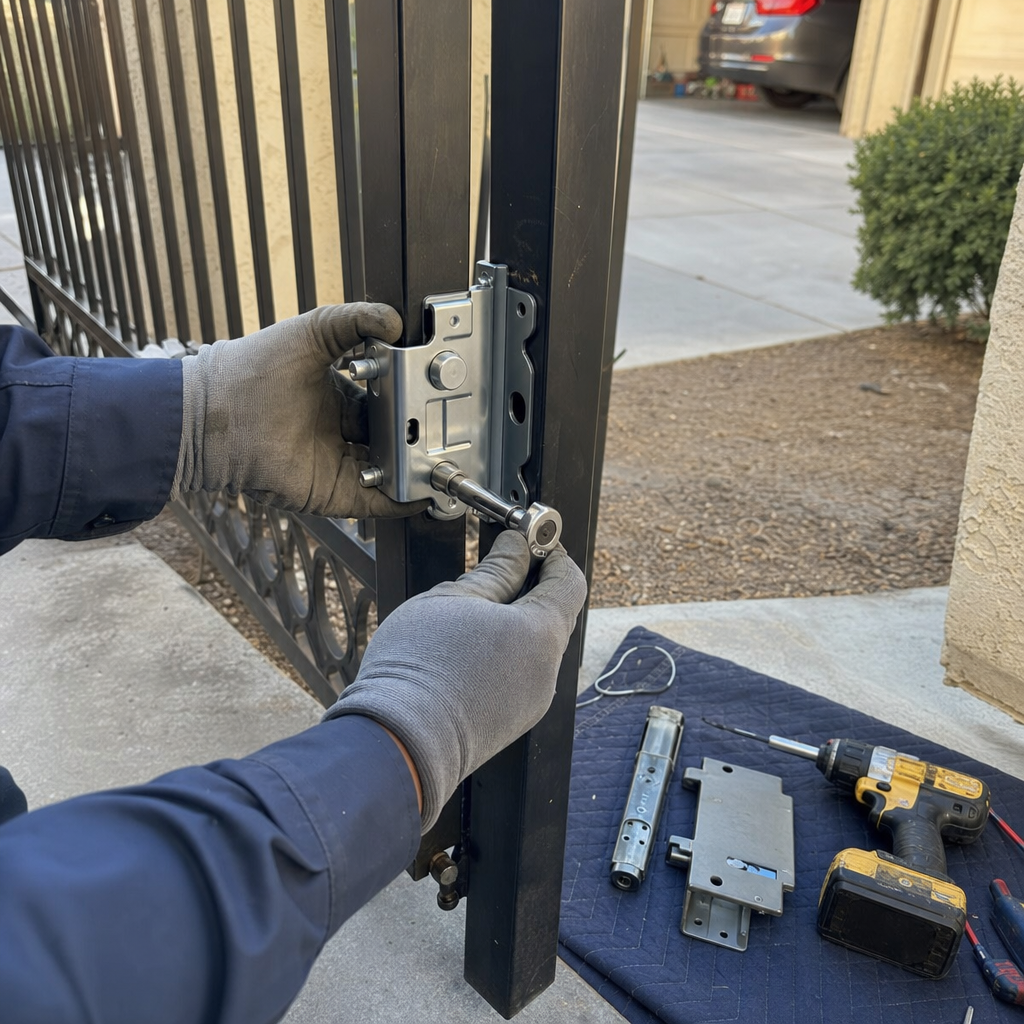
- Latch and lock hardware: Cycle the gate manually with the operator disconnected. The gate should move freely and latch with light pressure. If it requires more than 20 lbs of push force to latch, something is misaligned — and your operator is absorbing that resistance on every close cycle.
- Arm and bracket connections (swing gates): Inspect the operator arm at both the gate bracket and the post bracket. Elongated bolt holes are a sign of accumulated impact load — common when a gate has been hit by a vehicle or has been fighting a mechanical obstruction.
Our All Star Gate Repair Las Vegas home page covers the full range of structural repair services we provide, including on-site welding and parts fabrication — work that most operators in the valley outsource or decline entirely.
7. Access Control and Safety Sensor Check
Access control components — keypads, card readers, loop detectors, and intercom systems — are often the last thing homeowners think to maintain and the first thing to cause a service call. In Las Vegas, outdoor keypad faces become brittle and crack from UV exposure, loop detector wire insulation degrades in the road surface heat, and photocell lenses fog from the sun, causing safety sensors to trip intermittently or fail to detect at all.
Access Control Maintenance Steps
- Test all entry and exit devices monthly: keypads, remotes, card readers, and intercoms. Confirm each one triggers a clean gate cycle. A device that sometimes works and sometimes doesn’t is telling you something — log the failures and report them at your next service call.
- Inspect photocell (safety sensor) lenses for yellowing, fogging, or physical cracking. Clean with a soft cloth and isopropyl alcohol. If the lens is physically yellowed from UV degradation, the sensor needs replacement — cleaning won’t restore it.
- Test your vehicle loop detectors by driving over each one slowly and confirming the gate responds. If a loop detector has become intermittent, check for visible cracks in the road surface along the loop cut — crack sealant deteriorates in Las Vegas heat and allows water intrusion that corrodes the loop wire.
- For DoorKing and BFT access control systems, confirm firmware is current at least once per year. Both brands push updates that address security vulnerabilities and improve compatibility with rolling-code remotes. This isn’t a task for most homeowners — flag it for your technician.
- Check that all safety-reverse functions are working: place a 2×4 flat on the ground in the gate’s path and run a close cycle. The gate should reverse before completing contact with the board. If it doesn’t, the operator’s obstruction detection needs recalibration — this is a safety-critical function, not a minor adjustment.
Common Mistakes to Avoid
- Using manufacturer maintenance schedules without adjusting for Las Vegas climate. A LiftMaster or Mighty Mule manual written for a national audience assumes average conditions. Las Vegas isn’t average — double the lubrication frequency and cut battery replacement intervals by at least 30%.
- Ignoring a slow gate and attributing it to the motor. A gate that’s lost 20% of its opening speed has almost certainly developed a mechanical resistance problem — stiff hinges, debris in the track, thermal binding — before the motor shows any fault code. Replacing the operator without fixing the underlying drag means the new motor fails early too.
- Using spray lubricants on tracks and chains in summer. Wet lubricants applied in Las Vegas summer heat attract caliche dust within days, creating an abrasive slurry on moving parts. Use dry PTFE or high-temperature grease, not spray oil.
- Leaving the operator housing open after a maintenance check. We’ve seen gate operators in Summerlin and the southwest valley with housing covers left ajar, sometimes held by a misaligned tab. Even a small gap in the housing is enough to let caliche dust infiltrate the control board within a season.
- Resetting error codes without identifying the cause. If your FAAC, Viking, or Elite operator is throwing an error code, clearing it without diagnosing why it appeared isn’t a fix — it’s a countdown to the same failure, usually with more collateral damage.
- Skipping the manual-release test. Every gate operator has a manual release that lets you operate the gate during a power outage. Many homeowners have never tested it. In an emergency — fire, medical, extended outage — that’s the moment you find out the release handle is seized. Test it twice a year.
- Assuming a new installation doesn’t need maintenance for the first two years. In Las Vegas, the first summer after installation is often the hardest on a new gate system — thermal expansion, initial dust accumulation, and UV exposure all hit simultaneously. A post-installation check at six months is money well spent.
When to Call a Professional
Handle visual inspections, cleaning, lubrication, and basic battery tests yourself — but bring in a qualified technician when you hit any of the following situations. Call if your gate is reversing without an obvious obstruction: that symptom points to a limit switch fault, a safety sensor issue, or a control board problem that requires diagnostic equipment, not a screwdriver. Call if you see visible weld cracking on hinges or posts — structural repairs done wrong create liability and safety hazards. Call if your control board is showing an error code you can’t clear, if your operator sounds grinding or straining under normal load, or if any wiring shows cracks or exposed conductor. And call immediately if a vehicle has contacted the gate — the damage is rarely limited to what’s visible.
Gate Repair in Spring Valley and throughout the Las Vegas valley — Gerald and his team at All Star Gate Repair offer free estimates and carry parts for all nine brands we service. Call (725) 356-1660 to schedule.
Frequently Asked Questions
How often should I service my gate in Las Vegas?
Every six months is the minimum for residential gate systems in Las Vegas — April and October are the best timing, catching the system before summer heat peaks and before winter’s cold snaps. If your gate runs high daily cycle counts (a busy rental property or a HOA entrance), quarterly inspection is appropriate. The desert environment accelerates wear on every component compared to manufacturer baselines, which are written for moderate climates.
What is caliche dust and why does it damage gate motors?
Caliche is a calcium-carbonate-rich, alkaline soil material found throughout the Mojave basin, including most residential areas of Las Vegas. When dry, it becomes a fine, mildly conductive powder that infiltrates gate operator housings through gaps and conduit entries. Once inside, it coats circuit board traces and relay contacts, causing intermittent faults and — over time — shorts that damage or destroy control boards. It’s the most common environmentally-driven failure mode we see in the Las Vegas market, and it’s entirely preventable with twice-yearly housing cleanouts.
How long do gate operator batteries last in Las Vegas?
In Las Vegas conditions, plan to replace residential backup batteries every 18–24 months. Standard manufacturer recommendations of 3–5 years are based on average climate assumptions that don’t apply in the Mojave. Summer temperatures above 110°F, combined with grid fluctuations that cause partial battery cycling, shorten battery life significantly. Test backup function every 90 days during summer months — if the gate can’t complete five full cycles on battery alone, the battery is due for replacement.
Can I use WD-40 to lubricate my gate hinges?
No — WD-40 is a water-displacer, not a lubricant, and it evaporates quickly in Las Vegas heat. It leaves a residue that traps caliche dust and creates an abrasive film on hinge pins and pivot points. Use NLGI Grade 2 lithium complex grease on hinges and pivot points, and dry PTFE spray on tracks and rollers. These hold up above 110°F without attracting dust.
What should I do if my gate is slow to open or close?
A slow gate almost always signals a mechanical resistance problem before it signals a failing motor. Check hinges for stiffness, inspect the track or pivot for debris, and measure whether thermal expansion is causing binding at the latch post or stop. If the gate moves freely by hand (with the operator disconnected) but is still slow under power, the issue may be in the motor or drive system itself. Don’t ignore a slow gate — the added strain shortens operator life and can trigger overload shutdowns. For a free diagnostic estimate, call (725) 356-1660.
Do I need a permit to repair or replace my residential gate in Las Vegas?
Routine repair and maintenance — replacing motors, hinges, wiring, or access control components — generally doesn’t require a permit in Clark County. However, structural modifications such as relocating posts, changing gate openings, or adding a new automated system to a previously manual gate may require a permit through Clark County Building Department or the City of Las Vegas depending on jurisdiction. When in doubt, confirm with your local building department before starting structural work. Gerald and his team can advise on scope during the estimate visit.
The Bottom Line
A gate maintenance routine built for “somewhere in America” won’t protect a gate system in Las Vegas. Caliche dust, sustained UV exposure, extreme thermal cycling, and summer power fluctuations are specific, documented failure drivers in this market — and they hit harder than any other wear factor on the list. The homeowners who avoid expensive gate repairs in Las Vegas are the ones doing twice-yearly inspections, using the right lubricants for desert heat, replacing batteries on a desert-appropriate schedule, and catching wiring degradation before it becomes a board failure. If any part of this checklist reveals a problem you’re not equipped to handle, Gerald and his team are ready to take it from there.
For Gate Installation in Spring Valley or anywhere in the Las Vegas valley, and for full repair, motor service, and access control work on all nine brands we cover — call (725) 356-1660 for a free estimate. You can also learn more about our Gate Motor & Opener in Spring Valley services if your operator is due for a replacement or upgrade.
Ready to schedule your Las Vegas gate maintenance check? Call All Star Gate Repair at (725) 356-1660. Estimates are free, Gerald handles the work personally, and we carry parts for LiftMaster, FAAC, BFT, Linear, Viking, Ghost Controls, DoorKing, Elite, and Mighty Mule on every service call.
Written by Gerald Russell, Owner & Lead Technician at All Star Gate Repair Las Vegas, serving Las Vegas since 2021.