
Last updated July 15, 2026
Gate Repair Permits, Codes & Inspections in NV: What You Need to Know
A Spring Valley homeowner called us after one of the more frustrating outcomes we hear about in this trade: she’d just had a new gate operator installed with hardwired access control, the home went under contract, and the buyer’s inspector flagged the electrical work as unpermitted in roughly ten minutes. The deal nearly fell apart. She ended up paying to have the wiring pulled, re-permitted, and re-inspected before close — adding weeks and real dollars to a process that should have been straightforward. That situation wasn’t the exception. In Las Vegas and Clark County, we see it happen every time someone assumes that gate work is always exempt from permit requirements. This guide draws the actual line — so you don’t find out where it is at the worst possible moment.
Quick Answer
In Nevada, minor gate repairs — replacing a broken spring, swapping a control board, or adjusting alignment — don’t require a permit. But any work that involves new electrical wiring, structural modification, motor relocation, or installation of a new gate or operator in Clark County typically does. HOA approval is a separate requirement that runs parallel to municipal permits and can stop a project independently. Skipping either one creates real liability at resale and can affect insurance claims.
Table of Contents
- Repair vs. Alteration: Where the Permit Threshold Actually Sits in Clark County
- HOA Approval vs. Municipal Permits: How They Interact and Which One Can Stop You
- Electrical Permit Requirements for Access Control and Intercom Integration
- What an Inspector Actually Looks For: Gate Installation vs. Gate Repair
- How Unpermitted Gate Work Affects Insurance Claims and Title Transfers in Nevada
- Nevada Codes That Apply to Automated Gates
- How to Pull a Gate Permit in Clark County: Step-by-Step
- Common Mistakes to Avoid
Repair vs. Alteration: Where the Permit Threshold Actually Sits in Clark County
Clark County and the City of Las Vegas draw the line between “repair” and “alteration” in ways that matter for gate work specifically. A repair restores existing function without changing scope, location, or electrical load. An alteration changes any of those things — and that’s what triggers a permit requirement.
Here’s how that plays out in practice:
- Replacing a gate motor with an equivalent unit at the same location: Generally treated as a like-for-like repair. No permit required in most Clark County jurisdictions as long as no new wiring is run and the existing electrical circuit is not modified.
- Relocating a gate motor to a new post position: This is an alteration. New structural anchoring, potentially new conduit, and a changed equipment footprint all push this into permit territory.
- Replacing a damaged gate panel with the same dimensions: Repair. No permit in most cases.
- Adding a second gate where none existed: Installation. Full permit required — mechanical and likely electrical.
- Upgrading from a keypad to a full video intercom with cloud access: New low-voltage or line-voltage wiring almost always requires an electrical permit, even if the gate structure itself doesn’t change.
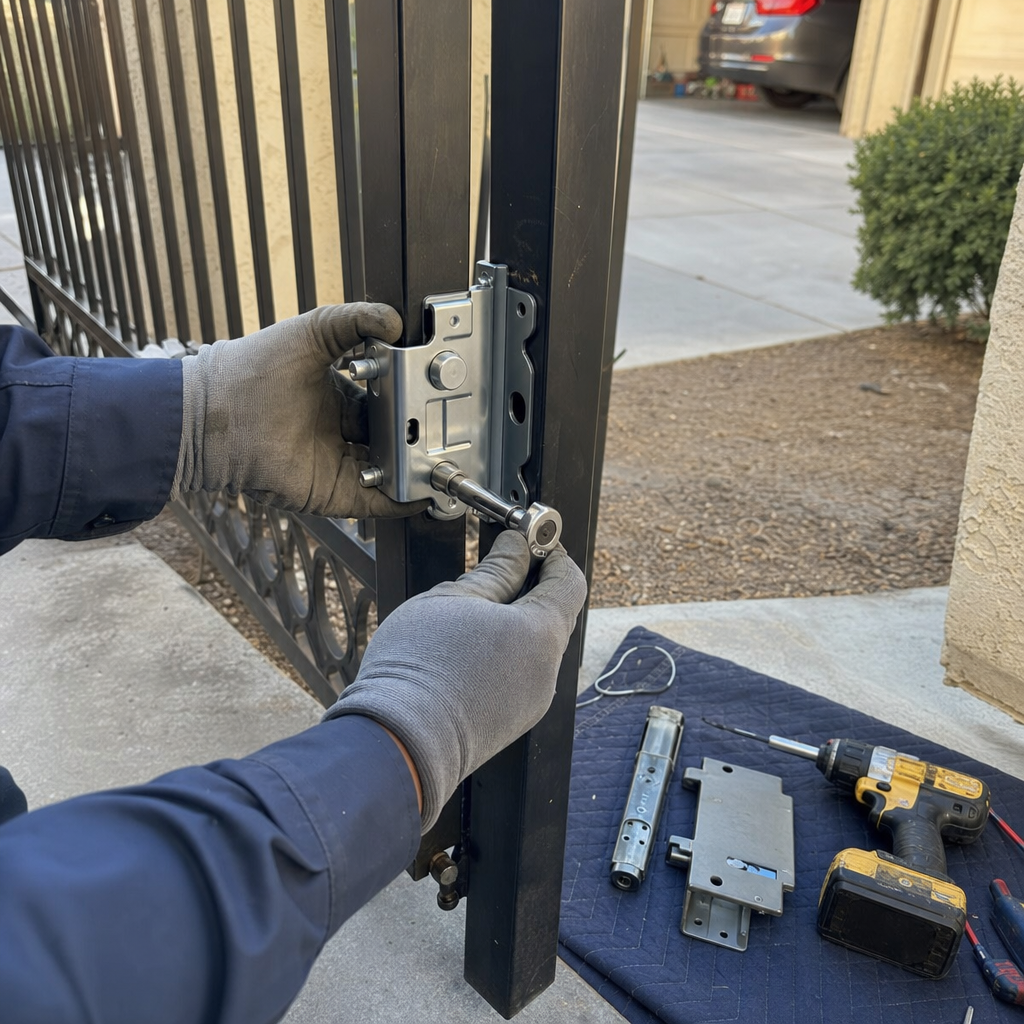
- Welding a broken hinge or reinforcing a frame in place: Structural repair to existing infrastructure — no permit in Clark County, though HOA rules may still apply.
The honest rule of thumb: if the work ends with the gate functioning the same way it always did, you’re likely in repair territory. If it ends with something new — a new circuit, a new location, a new structural element — plan for a permit. See our Seasonal Gate Repair Care for Las Vegas: Year-Round Homeowner’s Guide for maintenance that keeps your system in repair territory. When we do jobs in Spring Valley or Summerlin where HOA covenants layer on top of county rules, we always advise property owners to check both before the first tool comes out.
HOA Approval vs. Municipal Permits: How They Interact and Which One Can Stop You
This is the point where a lot of Las Vegas area homeowners get tripped up: they think getting a county permit means they’re cleared to proceed. HOA approval is a completely separate process governed by private CC&Rs (Covenants, Conditions & Restrictions), and an HOA can block work that is fully permitted by Clark County — and vice versa.
Here’s how they relate:
- Municipal permits are issued by Clark County Development Services or the City of Las Vegas Building & Safety Division. They regulate structural safety, electrical code compliance, and setback requirements. They don’t care about aesthetics or neighborhood standards.
- HOA architectural review governs appearance, materials, color, gate style, and sometimes brand. In communities like Anthem, Seven Hills, or Southern Highlands, the architectural review committee (ARC) has authority to require specific finishes or reject gate styles that don’t match community standards — even if the gate is structurally sound and fully permitted.
- Which one can stop a project? Either. An HOA can compel you to remove an approved gate if it violates CC&Rs. A county inspector can fail unpermitted work regardless of HOA sign-off.
The sequence matters: submit your HOA architectural review application first, because that process takes longer — often 30 to 60 days in larger Las Vegas master-planned communities. Once you have written ARC approval, pull your county or city permit. That order prevents you from holding a permit for work that the HOA then refuses.
For commercial properties in Las Vegas — apartment complexes, retail centers, industrial parks — HOA-style rules may instead come from a commercial property association or a recorded deed restriction. The principle is identical: private approval and government permit are parallel, not interchangeable.
Electrical Permit Requirements for Access Control and Intercom Integration
Nevada has adopted the National Electrical Code (NEC) with state amendments, and Clark County enforces it through its building department. When gate work touches electrical systems — even low-voltage ones — the permit question becomes more specific.
Under the NEC as adopted in Nevada:
- Line-voltage work (120V or 240V) — hardwiring a gate operator to a dedicated circuit, running conduit to a new panel breaker, or installing a GFCI outlet at a gate post — always requires an electrical permit and licensed electrical contractor sign-off in Clark County.
- Low-voltage access control — systems like DoorKing, LiftMaster’s MyQ integration, or BFT’s WIFI smart controllers — typically involve Class 2 wiring (under 50 volts). Nevada’s adopted NEC provisions for Class 2 circuits don’t always require a full electrical permit, but the installation still needs to comply with NEC Article 725 requirements for installation methods, wire separation, and power supply ratings.
- Telephone entry and video intercom systems — products like the DoorKing 1812 or Viking VK-Series intercoms that tie into existing phone or broadband infrastructure — fall under Class 3 or communications wiring rules. In Clark County, low-voltage installations that don’t modify line-voltage circuits are often exempt from permit, but any new home run back to a panel is not.
The practical takeaway: if a technician is running new wire of any kind from the gate back to the house or to a power source, ask whether an electrical permit is required before work begins. In our experience working on LiftMaster, FAAC, and Elite systems across Las Vegas, the line-voltage work almost always needs a permit; the low-voltage integration usually doesn’t — but the distinction depends on the specific scope, and “usually” isn’t good enough when you’re selling the house later.
What an Inspector Actually Looks For: Gate Installation vs. Gate Repair
If you’ve pulled a permit and are waiting on inspection, here’s what a Clark County inspector typically evaluates — and how to be ready.
For a New Gate Installation
- Post footing depth and concrete encasement. In Las Vegas, the frost depth is minimal, but inspectors verify that gate posts are set deep enough for soil conditions and gate weight. Heavy iron driveway gates on sandy desert soil can shift — footings matter.
- Operator mounting and hardware anchoring. The inspector will verify that the motor mount, arm brackets, and limit switches are installed per the manufacturer’s specs. Brands like FAAC and BFT have specific torque requirements for bracket fasteners that inspectors reference in product documentation.
- Safety device function. UL 325 compliance is required for residential and commercial automated gate operators. The inspector will test the photoelectric sensor or contact edge — if the gate doesn’t reverse on obstruction, it fails. This applies to swing, slide, and barrier operators.
- Electrical rough-in and final. For hardwired systems, the inspector checks conduit fill, wire gauge relative to breaker amperage, GFCI protection where required, and weatherproof enclosure ratings at outdoor outlets and control panels.
- Signage. Commercial gate installations in Clark County often require warning placards — “CAUTION: AUTOMATIC GATE” signage visible from both sides of the gate.
For a Permitted Repair or Alteration
- The inspector compares the permitted scope of work to what was actually done. If you permitted “motor replacement” and they find new conduit running to the house, that’s a scope change that needs to be addressed.
- Safety device re-testing is common even on alterations — particularly if a motor swap changed the gate’s force or travel speed.
- The inspector may ask for the operator’s installation manual on-site to verify compliance with manufacturer specs. Having that document available speeds up the inspection significantly.
How Unpermitted Gate Work Affects Insurance Claims and Title Transfers in Nevada
The Spring Valley homeowner in our opening didn’t just face a paperwork delay — she faced potential liability that extended in two directions: her insurance and her title. Both are worth understanding before you skip the permit on what feels like a minor job.
Homeowner’s insurance: Nevada home insurance policies typically include a clause that limits or excludes coverage for losses arising from work that wasn’t properly permitted. If an unpermitted gate operator causes a fire because the line-voltage wiring wasn’t code-compliant, an insurer has grounds to deny the claim or reduce the payout. This is a low-probability outcome, but it’s not hypothetical — it happens in Clark County, and it happens with gate electrical work specifically.
Title transfers: Nevada requires sellers to disclose known material defects and unpermitted improvements on a property disclosure form. Unpermitted gate work — especially any structural modification or electrical installation — qualifies. A buyer’s home inspector who finds evidence of unpermitted electrical work (mismatched conduit runs, breakers added without panel documentation) can make it a condition of sale, as happened in the case above. The resolution options are: retroactive permit (possible but expensive and uncertain), removal and re-installation to code, or a price reduction that reflects the liability the buyer is inheriting.
Clark County permit records are searchable. Any buyer’s agent or title company can pull permit history on a Las Vegas address in minutes. If the gate was installed or significantly modified and no permit appears in the record, that’s a flag — regardless of whether it’s ever brought up before listing.
Nevada Codes That Apply to Automated Gates
Several code frameworks converge on automated gate systems in Nevada. Knowing which ones apply helps you ask the right questions of any contractor — including us.
- UL 325 (Operator Safety Standard): Not a government code but referenced by Clark County inspectors. All gate operators sold and installed in the U.S. must meet UL 325 for entrapment protection. This standard specifies required safety devices by gate type and application — residential pedestrian, commercial vehicular, etc. LiftMaster, FAAC, BFT, Linear, Elite, and Mighty Mule all manufacture UL 325-listed operators.
- ASTM F2200 (Automated Vehicular Gate Standard): Covers the physical gate structure itself — clearances, protrusion hazards, and the relationship between gate geometry and entrapment risk. Relevant on any new gate installation or structural alteration.
- Nevada Administrative Code (NAC) Chapter 624: Governs contractors in Nevada. Gate installation work that involves electrical components must be performed by appropriately licensed contractors — the specific license category depends on the scope. This is why gate companies that do their own electrical work in Nevada need to carry proper contractor classification, not just a business license.
- NEC Articles 725, 800, and Chapter 3: These govern the wiring methods and circuit classifications most common in gate access control installations in Las Vegas — from the 120V service to the operator to the low-voltage runs feeding intercoms, card readers, and loop detectors.
How to Pull a Gate Permit in Clark County: Step-by-Step
This process applies to properties in unincorporated Clark County. If your property is within the City of Las Vegas, Henderson, North Las Vegas, or another municipality, the issuing agency changes but the steps are broadly similar.
- Determine your jurisdiction. Use the Clark County GIS portal to verify whether your address is in unincorporated Clark County or within a city limit. The permit office changes; the process doesn’t vary dramatically.
- Prepare your project description. Write a clear scope of work: what’s being installed or modified, the operator make and model (e.g., LiftMaster SL3000 slide gate operator), post dimensions, and any electrical work. The more specific, the faster the review.
- Submit to Clark County Development Services (CCDS). As of 2025, Clark County accepts permit applications through its online portal. Residential gate permits are often processed as over-the-counter permits for straightforward scopes — same-day or next-day issuance is common for simple motor installations.
- Pay the permit fee. Permit fees in Clark County scale with project valuation. A straightforward gate operator installation might carry a fee in the $75–$200 range; an installation that includes electrical work will carry a separate electrical permit fee.
- Post the permit on site. The permit card must be displayed visibly during work.
- Schedule rough-in inspection (if electrical work is included). Before the walls or conduit runs are covered, the electrical rough-in must be inspected. Call CCDS to schedule — inspections are typically within one to three business days.
- Complete the work and schedule final inspection. The final inspection covers completed operator installation, safety device testing, electrical final, and signage where required. A passing final is what closes the permit and creates the record.
- Obtain your Certificate of Occupancy or final permit card. Keep this document with the property records. At closing, your title company will want to see it.
Common Mistakes to Avoid
- Assuming “it’s just a repair” without confirming the scope. The permit threshold isn’t about how big the job feels — it’s about whether the electrical or structural footprint changes. A five-minute motor swap that adds a new circuit is a permitted alteration, not a repair.
- Getting HOA approval but skipping the county permit. HOA sign-off is not a substitute for a Clark County permit. We’ve seen jobs in Summerlin and Henderson where the HOA approved the gate style and the county rejected the install because no permit was pulled — the owner had to start over.
- Letting a non-licensed contractor handle the electrical connection. In Nevada, connecting an operator to line voltage requires the right contractor license classification. An unlicensed hookup is unpermittable even retroactively in most cases, which means the wire has to come out.
- Not testing UL 325 safety devices before the inspector arrives. If the photoelectric sensor or contact edge isn’t properly adjusted, the gate will fail inspection. This is one of the most common reasons for re-inspection fees — it takes two minutes to test and avoid entirely.
- Failing to disclose unpermitted work on a Nevada seller’s disclosure form. Known unpermitted work that isn’t disclosed creates legal exposure for the seller beyond just the repair cost. In a Las Vegas real estate market where buyers’ inspectors are thorough, the assumption that it won’t be found is a bad bet.
- Skipping the manufacturer’s installation manual during inspection. Clark County inspectors reference manufacturer documentation to verify compliance. Not having the manual on-site for a Viking, Ghost Controls, or Elite operator can slow or fail an otherwise clean inspection.
- Waiting until listing to address permit issues. Retroactive permits are possible in Clark County but not guaranteed, and the process is more expensive and slower than pulling the permit upfront. Dealing with it before listing — or before you need it — is always the lower-cost path.
When to Call a Professional
Call a professional before the work starts — not after — when any of these apply:
- The gate needs new wiring of any kind, including low-voltage access control runs.
- You’re replacing an operator and aren’t certain whether the existing circuit is the right amperage for the new unit.
- The gate structure has been damaged — bent posts, cracked hinges, a frame out of plumb — and you’re not sure whether repairs require a structural permit.
- Your HOA has an architectural review process and you need documentation of the proposed scope before submitting.
- You’re buying or selling a Las Vegas property and want to verify that existing gate work was properly permitted before it shows up in a title search.
Gerald and his team at All Star Gate Repair Las Vegas can walk you through what your specific job requires before a single tool comes out. We’ve worked through Clark County permits, HOA submissions, and UL 325 inspections on systems ranging from simple Mighty Mule residential openers to multi-gate DoorKing commercial access control setups. Call (725) 356-1660 for a free estimate — we’ll tell you exactly what the job involves, including whether a permit is part of it.
Frequently Asked Questions
Replacing a gate motor with a like-for-like unit at the same location, using the existing electrical circuit, typically does not require a permit in Clark County. If you’re running new wiring, changing the circuit, or relocating the operator to a new mounting position, that crosses into alteration territory and a permit is required. Call (725) 356-1660 if you’re not sure which category your job falls into — we’ll give you a straight answer at no charge.
No. HOA approval and a Clark County permit are completely separate requirements. An HOA architectural review committee approves the aesthetics and materials of your gate under private CC&Rs. Clark County Development Services issues permits for structural and electrical compliance under public building codes. You need both when both apply — and neither one substitutes for the other.
Nevada’s seller disclosure law requires you to disclose known unpermitted improvements. A buyer’s inspector can identify signs of unpermitted electrical work — and Clark County permit records are publicly searchable — so it’s likely to surface. The buyer can make remediation a condition of sale, which means either pulling a retroactive permit, removing and re-doing the work, or accepting a price reduction. Addressing it before listing is consistently the lower-cost path.
Low-voltage Class 2 wiring for access control systems — card readers, keypads, wireless receivers — is often exempt from an electrical permit in Clark County, as long as it doesn’t touch or modify the line-voltage circuit feeding the operator. The moment a new line-voltage circuit is added or an existing one is modified, an electrical permit is required. Nevada’s adopted NEC provisions still require Class 2 installations to follow correct wiring methods even when no permit is pulled.
UL 325 is the governing safety standard for gate operators in the U.S. and is referenced in Clark County inspections. It requires that automated gate operators include entrapment protection — typically a photoelectric sensor, a contact-sensing edge, or both — appropriate to the gate’s application. ASTM F2200 governs the physical gate structure’s geometry and clearances. Every major brand we work with — LiftMaster, FAAC, BFT, Linear, Elite, Viking, and the others — manufactures UL 325-listed operators, but they still have to be installed and calibrated correctly to pass inspection.
For a straightforward residential gate operator installation, Clark County Development Services often issues permits over the counter or within one business day through its online portal. Projects that include electrical work may require a separate electrical permit review, which typically adds two to five business days. HOA architectural review runs parallel to this and commonly takes 30 to 60 days in larger Las Vegas master-planned communities — which is why starting the HOA process first, before pulling the county permit, is the right sequence. For gate installation in Spring Valley or other HOA-heavy communities, we always advise clients to build that timeline in from the start.
The Bottom Line
Most Gate Repair services in Las Vegas and Clark County don’t require a permit — but the ones that do are exactly the jobs that homeowners tend to assume are exempt: new wiring, operator relocation, access control upgrades, and new installations. The cost of skipping a permit isn’t paid at the job — it’s paid at the title company, or in an insurance denial, or in a teardown and redo. The threshold isn’t complicated once you know where it sits: new electrical or structural footprint means a permit. Like-for-like repair at the same location usually doesn’t. HOA approval and municipal permits are parallel requirements, not interchangeable. Know both before you start.
If your gate needs work and you want a clear answer on what the job involves — permit requirements included — call All Star Gate Repair Las Vegas at (725) 356-1660. Gerald and his team work on every major brand, handle structural welding in the field, and have been through this process dozens of times across Las Vegas, Spring Valley, Henderson, Summerlin, and beyond. Free estimates, no runaround.
For homeowners already working through a gate repair in Spring Valley, or evaluating whether a motor replacement makes sense, our team can assess the full scope — gate motor and opener service in Spring Valley included — before any permit or HOA submission is needed.
Written by Gerald Russell, Owner & Lead Technician at All Star Gate Repair Las Vegas, serving Las Vegas since 2021. Browse our more guides & resources.