Top Signs You Need Gate Repair Service — Don’t Ignore These
A gate that’s slowing down isn’t just a minor annoyance; it’s often a sign that the structure itself is failing, forcing the motor to overwork. In Las Vegas, where extreme temperatures can exacerbate existing issues, ignoring these subtle warnings can lead to more costly, complex repairs down the line. We’ve seen countless situations where homeowners waited too long, turning a simple adjustment into a full system overhaul. Recognizing these early indicators can save you significant time and money, especially when dealing with the harsh Nevada sun.
If you’re experiencing gate issues and would rather not try a DIY fix, give us a call at (725) 356-1660 for a free estimate. We’re the All Star Gate Repair Las Vegas home for reliable service.
Structural Integrity: The Unseen Warning Signs
Most people focus on the motor or remote when their gate acts up, but the real problems often start with the gate’s physical structure. Think of it like a house: if the foundation is shifting, the whole building will eventually show signs of stress. For a gate in Las Vegas, this means looking for subtle changes that indicate the frame is warping, posts are leaning, or hinges are weakening. These aren’t problems you’ll hear or feel directly from the motor, but they’re the root cause of many mechanical failures we diagnose. We often find that a gate that’s not closing perfectly level, or has an uneven gap at the top versus the bottom, is already putting immense strain on its operator. In the intense Las Vegas heat, metal expands and contracts, which can accelerate these structural shifts if they’re already present. Catching these early can prevent the motor from burning out prematurely.
Here are some structural indicators to watch for:
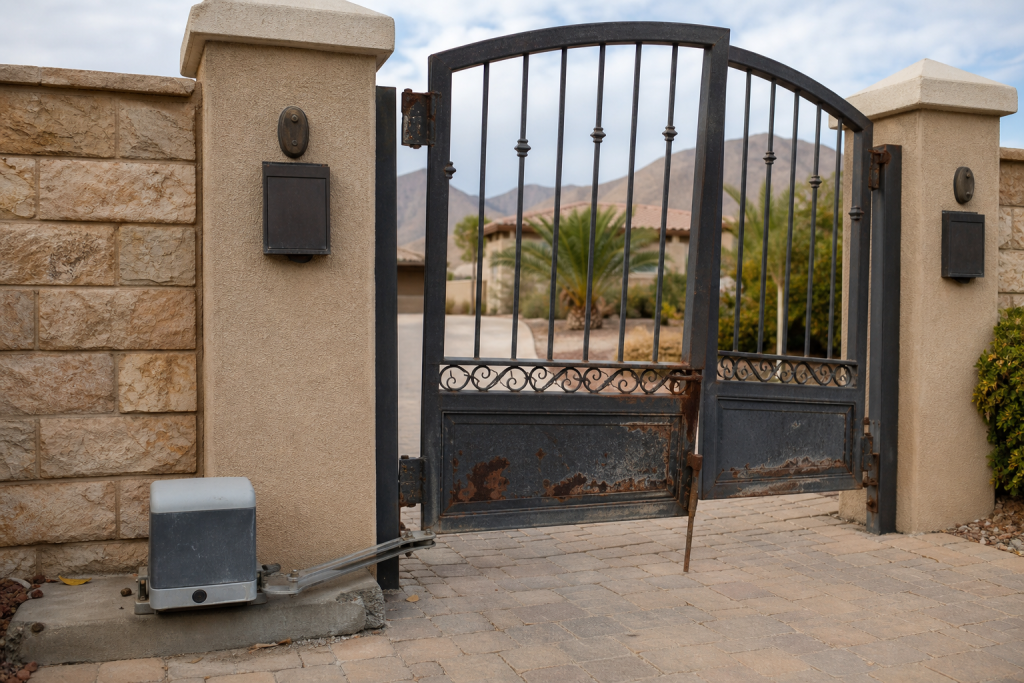
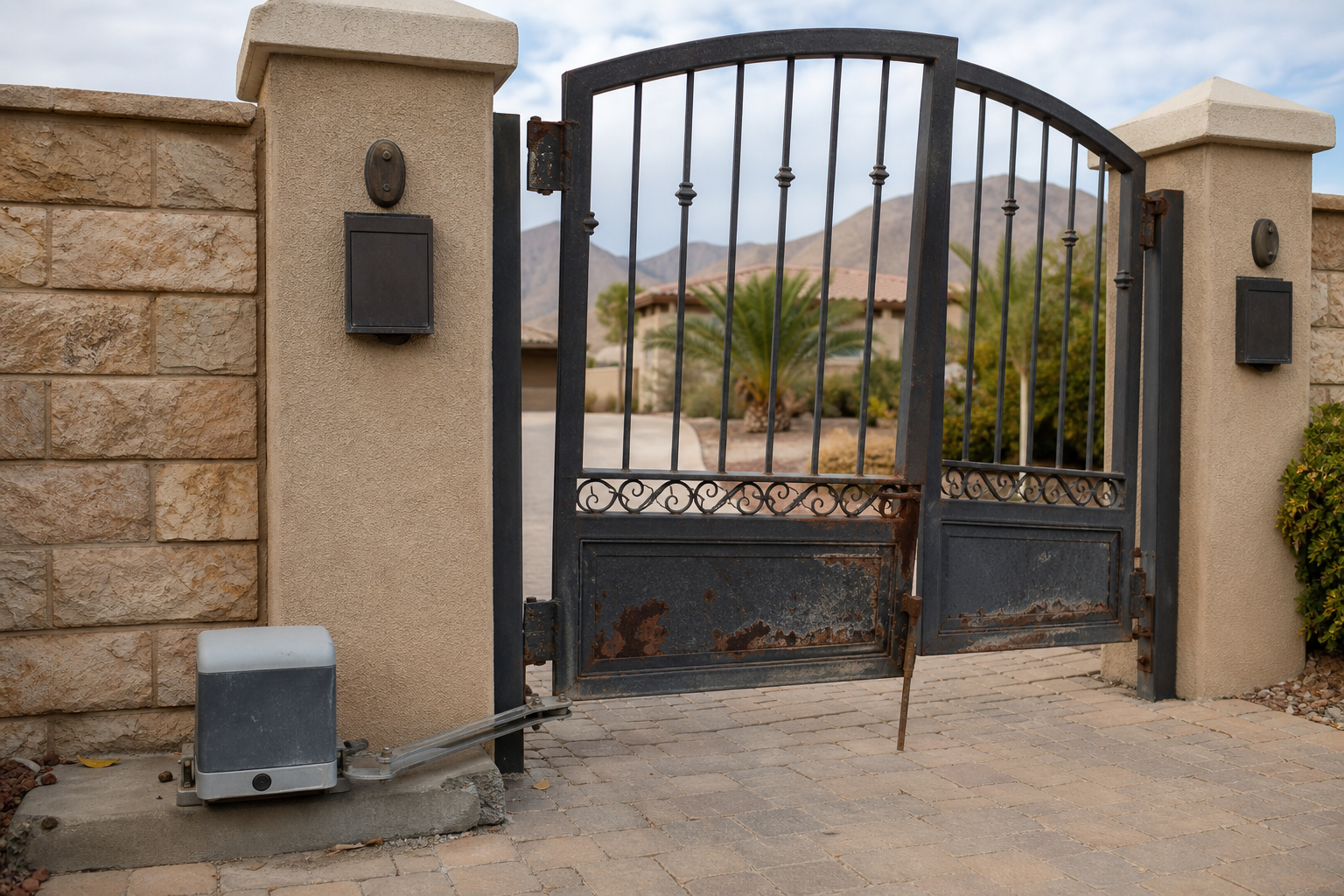
- Uneven Gaps: Check the space between the bottom of the gate and the ground, and compare it to the space at the top. If one side is significantly higher or lower, the gate’s frame might be out of square. This is a common early sign of structural stress, especially on swing gates.
- Rust at Weld Seams: While some surface rust is normal, excessive or bubbling rust around weld points, especially on the gate frame or hinges, can indicate internal weakness. This is particularly important in areas like Las Vegas where humidity can sometimes be a factor after monsoons, leading to unseen corrosion.
- Post Lean or Movement: Gently push on the gate posts. If they feel loose, wobbly, or you can see they’re not perfectly plumb (straight up and down), the foundation of your gate system is compromised. This can cause the gate to bind or drag, leading to motor issues.
- Hinge Wear: Inspect the hinges for signs of excessive wear, bending, or cracking. Worn hinges can cause the gate to sag, which again puts undue stress on the operator.
We frequently encounter these issues in neighborhoods like Summerlin and Henderson, where properties often feature substantial, custom-built gates that require meticulous structural maintenance.
Electrical Clues: Decoding Your Gate’s Status Lights
Gate operators, whether LiftMaster, FAAC, or BFT, are sophisticated electronic devices. They often communicate their health status through indicator lights on the control board. While many homeowners might dismiss a blinking light as a minor glitch, these patterns can be crucial diagnostic tools, signaling impending failure long before a complete breakdown occurs. In Las Vegas, the intense ultraviolet (UV) rays from the sun can degrade wiring insulation over time, making electrical components more susceptible to damage. This is why understanding the basic electrical signals your gate system is sending is so important. A small electrical issue, if left unaddressed, can cascade into a much larger problem, potentially damaging more expensive components like the logic board or motor.
Pay attention to these electrical warnings:
- Control Board Indicator Lights: Most gate operators have LEDs that flash in specific sequences to indicate errors. For example, a LiftMaster or Viking gate might show a pattern that points to a limit switch issue or a problem with the safety sensors. Consulting your gate opener’s manual can help decipher these codes.
- Safety Sensor Malfunctions: If your gate repeatedly fails to close or reverses unexpectedly, it’s often a sign that the safety sensors are misaligned, dirty, or damaged. While this can be a simple fix, persistent issues could point to a deeper electrical problem or even a structural issue causing the gate to miss the sensor beam.
- Remote Control Lag or Failure: While sometimes it’s just a dead battery, a consistently slow response from your remote, or the gate only responding intermittently, can indicate a weak signal or a problem with the receiver board. This is common with older systems or when exposed to harsh Las Vegas conditions.
- Overheating or Humming Sounds: If the gate operator makes unusual humming noises or feels excessively hot to the touch, it’s a clear sign it’s working too hard. This is often a symptom of mechanical resistance caused by structural issues, rather than a motor failure itself.
We’ve serviced many DoorKing and Elite systems in commercial properties across Las Vegas, where reliable access control is paramount, and these electrical clues are often the first alerts we get.
Mechanical Symptoms: When the Gate Itself Isn’t Moving Right
This is where most people start noticing something is wrong. The gate might be sluggish, noisy, or stop mid-way. However, it’s crucial to understand *why* it’s behaving this way. Is the motor failing, or is the gate simply fighting against resistance caused by structural issues? Distinguishing between these two is key to getting the right repair, and often, it’s the structural problem that’s the primary culprit. In Las Vegas, we see gates that have been compensating for bent frames or misaligned posts for so long that the motor is essentially on its last legs. Replacing the motor without addressing the underlying structural defect is a temporary fix that will lead to premature motor failure again.
Here’s what to look for in mechanical operation:
- Slow Operation: A gate that moves slower than it used to is a classic sign of strain. This could be a motor issue, but more often, it’s the gate mechanics (wheels, tracks, hinges) or the structural frame causing the resistance.
- Grinding or Squealing Noises: These sounds are rarely good. They often indicate worn-out gears in the motor, dry or damaged bearings in the gate wheels, or metal-on-metal friction due to misalignment. We hear these often on older Mighty Mule or Ghost Controls openers.
- Jerky or Stuttering Movement: If the gate doesn’t open or close smoothly, it suggests an obstruction, a problem with the drive chain or belt, or an issue with the motor’s internal components.
- The Gate Stops Mid-Cycle: This is a critical warning. It means the motor has encountered too much resistance, or a safety mechanism has been triggered due to an obstruction or a limit switch problem. In Las Vegas, this could be due to debris from a dust storm getting lodged in the track, or heat-related expansion causing a bind.
We often tell clients in the Las Vegas area that a gate that sounds like it’s grinding is like a car engine making a terrible noise – you don’t want to ignore it!
Access Control & Remote Issues: More Than Just Electronics
Keypads, card readers, and even remote controls are the gate’s “brain” when it comes to granting access. When these systems malfunction, it’s easy to assume the electronics are the problem. However, in many cases, the access control system is reporting errors because the gate itself isn’t operating correctly. For example, a keypad might display an error if the gate fails to reach its fully open or closed position within the expected timeframe, or if it doesn’t engage its internal lock mechanism properly. This is especially true for more complex systems we service, like those from DoorKing or Linear, which have sophisticated communication protocols with the gate operator.
Consider these access control symptoms as potential gate issues:
- Keypad/Card Reader Errors: If your access control system consistently shows error messages, it might not be the keypad itself, but the gate’s inability to respond as expected to the command. This can happen if the gate is binding or the limit switches aren’t registering correctly.
- Remote Control Range Issues: A reduced range for your remote could be a simple antenna problem, but it can also be related to electrical interference caused by other devices, or even a weak signal from the operator itself due to it struggling to move the gate.
- Intercom System Problems: If your intercom system is having trouble connecting or is garbled, it could be related to the gate’s power supply or the integrity of the wiring, especially if exposed to the Las Vegas elements for years.
- Automated Gate Not Locking/Unlocking: This is a serious security concern. If the gate’s auto-lock feature isn’t engaging, or if it’s failing to unlock, it could be a mechanical issue within the gate mechanism or the operator, not just the electronic lock component.
We’ve seen many properties in the Las Vegas Strip area and Downtown Las Vegas that rely on robust access control, and we always check the gate’s physical operation first when these systems falter.
The Compounding Failure Sequence: Why Las Vegas Heat Makes It Worse
In a place like Las Vegas, heat isn’t just uncomfortable; it’s an active agent of wear and tear on mechanical systems. When a gate shows early signs of trouble – a slight sag, a bit of sluggishness, a faint grinding noise – and these are ignored, the problem doesn’t stay isolated. The motor has to work harder, leading to increased wear. This increased wear can then cause further mechanical binding, which puts even more strain on the motor and potentially the electrical components. What might have started as a simple hinge adjustment or a wheel replacement can quickly escalate into needing a new motor, a control board replacement, and structural repairs.
Here’s how a minor issue can snowball:
- Initial Symptom: A gate frame warps slightly due to extreme temperature fluctuations.
- Compensating Motor: The gate operator, designed to overcome some resistance, works harder. This leads to faster wear on its internal gears and brushes.
- Increased Resistance: The warped frame causes the gate to bind more, straining the motor and potentially damaging tracks or wheels.
- Electrical Strain: The overworked motor can draw more power, potentially affecting the control board or causing wiring to overheat.
- Mechanical Failure: Eventually, the motor burns out, a gear strips, or a wheel seizes.
- Structural Damage: The continued stress can cause posts to lean or hinges to break.
- The Result: What could have been a $200 repair for a bent frame or worn wheel now costs $900 for a new motor, plus the cost of structural repairs, and potentially a new control board.
We estimate that in Las Vegas, ignoring early gate issues can lead to needing three separate repairs within six months, when one timely intervention could have solved it all. It’s not uncommon for us to see this pattern in areas like Green Valley or Anthem, where property managers are juggling multiple gates.
When to Call a Pro
While some minor issues might be tempting to tackle yourself, recognizing the signs of structural, electrical, or significant mechanical problems is where professional expertise truly shines. If you notice any of the structural issues mentioned, persistent electrical codes on your control board, or if your gate is operating erratically or noisily, it’s time to call in the experts. Trying to force a gate that’s binding, or replacing a motor without understanding why it failed, can lead to further damage and increased costs. Our goal at All Star Gate Repair Las Vegas is to diagnose the root cause, not just treat the symptom, ensuring a lasting repair.
Related Services in Las Vegas:
The Bottom Line
Paying attention to your gate’s subtle cues—from the way it moves to the sounds it makes—is your best defense against unexpected failures. Structural integrity, electrical signals, and mechanical operation all work together, and problems in one area inevitably affect the others. In the challenging climate of Las Vegas, these issues can be amplified, turning minor inconveniences into costly emergencies. Don’t wait for a complete breakdown; recognizing these signs early is the smartest way to maintain your gate’s security and functionality. If you’re in Las Vegas and need help identifying or fixing these issues, All Star Gate Repair Las Vegas offers free estimates. Give us a call at (725) 356-1660.
Frequently Asked Questions
The most common signs that your gate needs repair include slow or jerky gate movement, unusual noises like grinding or squealing, remote control issues, and visible structural problems like leaning posts or sagging frames. These symptoms often indicate that the gate’s motor, mechanical components, or structural integrity are compromised.
It’s usually cheaper to repair a gate opener in Las Vegas if the issue is minor, such as a faulty sensor, a loose connection, or a worn gear within the motor. However, if the motor has completely burned out due to prolonged strain from a binding gate, or if the control board is severely damaged, replacement might be more cost-effective in the long run, especially considering the potential for further damage to other components. We always assess the underlying cause before recommending replacement.
You can attempt minor fixes like battery replacement for remotes or cleaning safety sensors. However, for issues involving structural integrity, electrical diagnostics on the control board, motor repairs, or complex access control systems, it’s best to call a professional. Incorrect DIY repairs can void warranties, cause further damage, and create safety hazards. Our team at All Star Gate Repair Las Vegas is equipped to handle these complex issues.
The extreme heat and significant temperature fluctuations in Las Vegas can accelerate wear and tear on gate systems. Metal components expand and contract, which can exacerbate existing structural weaknesses, cause binding, and stress motors. Intense UV exposure can also degrade wiring insulation and plastic components over time, leading to electrical issues. Regular maintenance is crucial to combat these effects.
Reviewed by Gerald Russell, Owner & Lead Technician at All Star Gate Repair Las Vegas, serving Las Vegas since 2021.
Need Gate Repair Help?
Call All Star Gate Repair Las Vegas — licensed & insured, here with fast after-hours help in Las Vegas.
(725) 356-1660